Examining Masters Myths
The Masters has always had an unusual relationship with the truth. For most of its history, Augusta National controlled what you saw, and the writers, players, and broadcast voices who witnessed the rest became the only available record. When Ken Venturi or Dan Jenkins made a claim, it became gospel. The myths accumulated gradually until they were just part of the landscape. It’s not a criticism as much as a reality of the information available. For 70 years, the data was greens in regulation, fairways hit, and total putts; statistics we now know to be relatively useless. Everything else came from memory, instinct, and a broadcast that didn’t show the front nine until 1997.
ShotLink changed that, recording every shot at Augusta since 2003. Data Golf went further, building models that measure strokes gained by yardage and lie type, decompose scoring variance hole by hole, and isolate exactly how much each skill category matters at a specific course under specific conditions. The beauty of the data is that it provides a way to test the stories we’ve told for decades. So let’s do that.
#1: Augusta is a second-shot golf course: FACT… to an extent
A second-shot golf course is a fancy way to say a course where approach play is a premium. Data Golf tracks what drives the variance in scoring in a given tournament. The model looks at the separation between players on a leaderboard and evaluates how much of the separation can be traced to each of the four major skills. If all of the players in the top-10 are also the 10 best putters that week, putting will possess a high fraction of the variance. Approach play drives over a third of the scoring at Augusta, but that’s true basically everywhere on Tour.
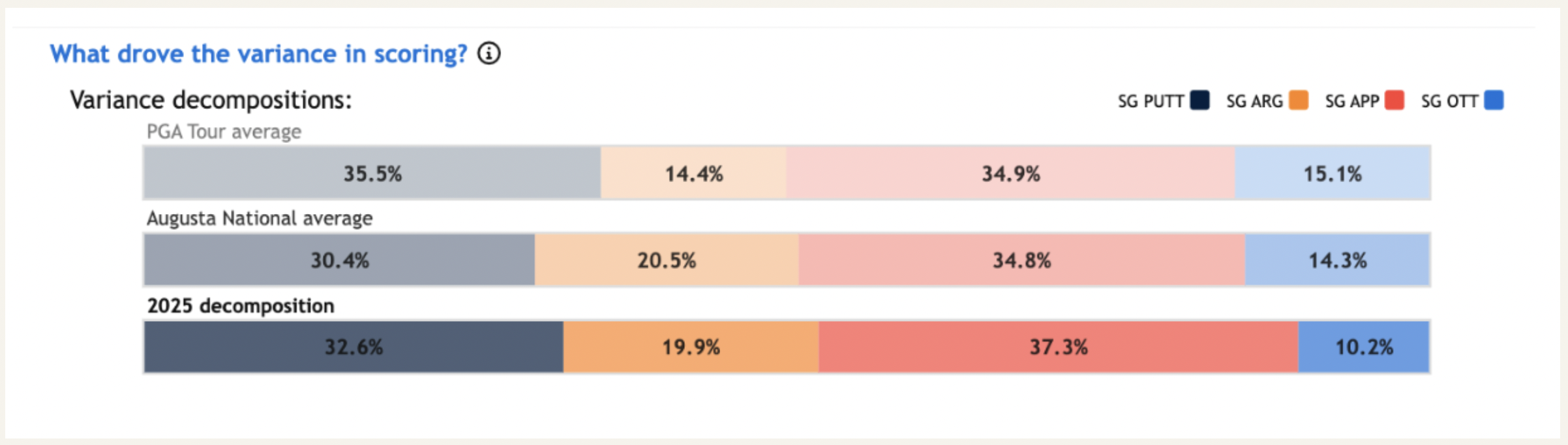
What makes Augusta different is which approach shots matter. Per tournament, Augusta produces 6 fewer shots from 100-150 yards, 4 more from 150-200 yards, and 3.2 more from 200+ yards than the average Tour stop. The players who lead the Tour from those longer distances are overwhelmingly the best in the world.
The table below shows the strokes gained per shot leaders from the last 12 months across the three main approach bins:
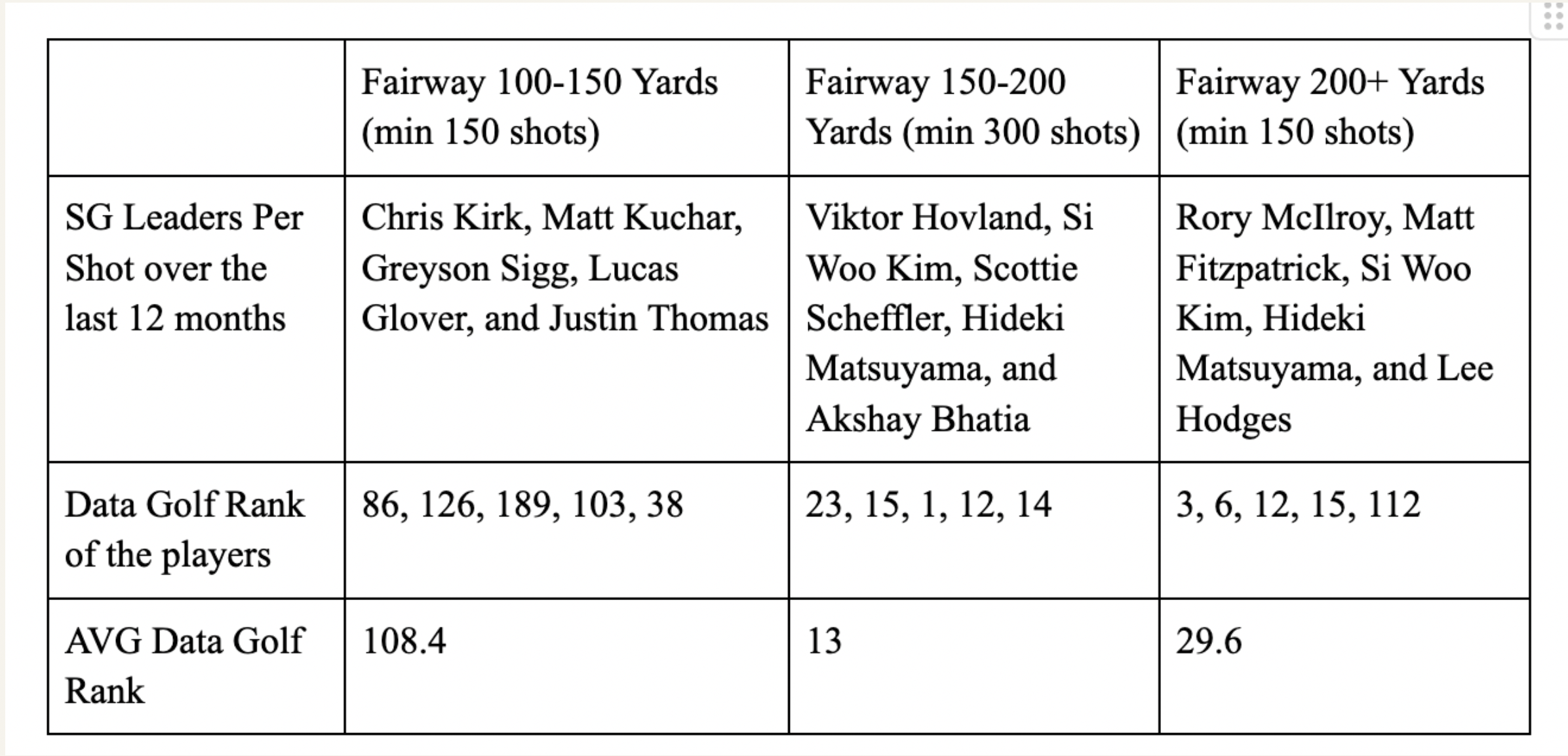
The myth is boosted by the fact that the best iron players tend to play well at Augusta. From inside 150 yards, the gap between the best and worst approach players narrows considerably. The variables compress: everyone is hitting a similar club, trajectory matters less, dispersion tightens, and most pins are accessible. Data Golf’s baseline function — the strokes-to-hole-out curve that underpins all strokes gained calculations — has a steeper slope from 200-250 yards than from 100-150. This means an improvement in shot quality is worth more strokes at longer distances.
It explains why certain players don’t see their usual advantage translate. Justin Thomas, for example, has been one of the best approach players of his generation, but much of that edge comes from wedge distances. With fewer shots coming from those ranges at Augusta, that advantage is reduced. Lee Trevino is the best player never to win at Augusta, and it is for the same reason.
So yes, Augusta is a second-shot course in the sense that approach play is central to scoring. But it’s not unique in how much approach matters. What makes it feel that way is that it pushes players into the part of the game where the best players are already separating themselves.
#2: You need to be an elite putter to win at Augusta: MYTH
There are two competing theories about putting at Augusta. The first is that the greens are so demanding that putting is crucial; if you can’t handle 14 on the Stimpmeter, you have no chance. The second is that Augusta is so difficult to putt that it equalizes the field, reducing the advantage of elite putters. The evidence points towards the latter, but it’s a bit more complicated.
On a typical Tour stop, putting accounts for roughly 35% of scoring variance. At Augusta, that drops to 30%, while around-the-green jumps to 20%. None of these four categories ever really disappears, so a five percentage point decrease is very significant. The reason for this difference is not just that Augusta is hard; rather, it produces a specific kind of difficulty that neutralizes skill.
Putting skill separates players most on mid-range putts, roughly 10-30 feet. Inside five feet, almost everyone converts, and beyond 30, almost nobody does. According to Data Golf, per tournament, Augusta produces 3.6 more putts from inside five feet and 2.4 more from beyond 30 feet than the average Tour stop. This is due to the sloping greens and the large number of funnel pins. Hit your spot with the iron, and you’re inside 10 feet. Miss it, and you’re looking at a long-range putt. There is less mid-range putting, meaning less room for skill to show up.
Putting is also the least predictive of the four major skill categories. Sometimes you hit good putts, but they don’t break as they should. The difference between a putt going in and a foot past is a full stroke. Most of the time, when you hit a good iron shot, it gets a good result. You might get a bounce that puts you 20 feet away rather than 15 feet, but that only reflects a fraction of a shot.
The end-of-season putting leader on Tour has recorded individual tournament weeks with negative strokes gained putting sixteen times across the past three years. Scottie Scheffler has not had a single negative approach week in that span. Similarly, the leading driver has had a negative week off the tee five times in the last six years.
The table below shows the strokes gained category leaders over the past five years:
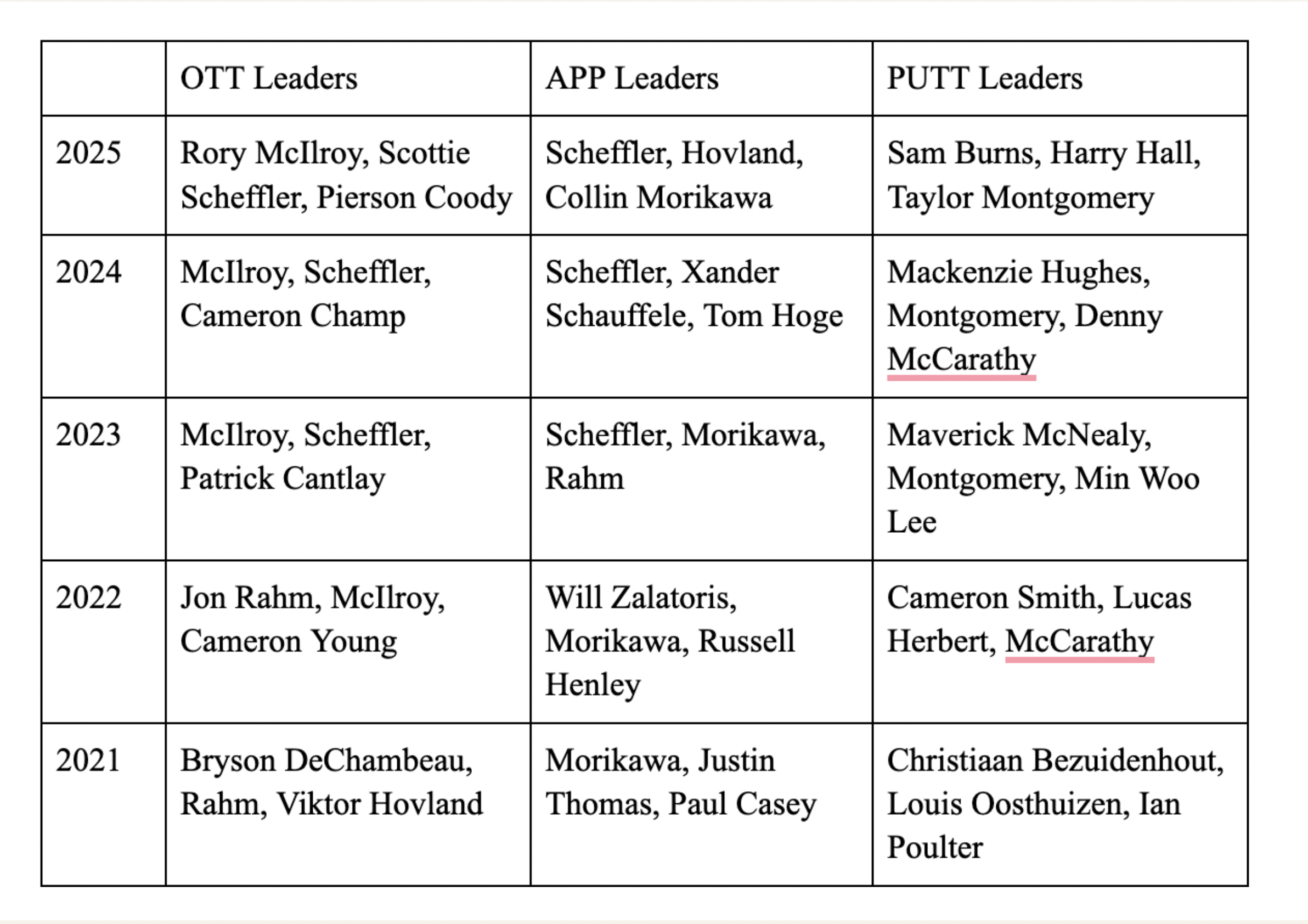
That volatility makes putting a poor predictor of winning anywhere on Tour, but Augusta amplifies it. I’m wary of pointing specifically to winners in statistics because they are only one data point each year. If you’re looking at distance as a predictor and the winner is a short hitter, but everyone else in the top ten is a bomber, you wouldn’t want to claim short hitters fared better. With that said, the fact that 15 of the last 18 Masters winners ranked outside the top 50 in strokes gained putting in the year leading up to their win is too significant to ignore.
#3: The tournament doesn’t start until the back nine of Sunday: MYTH
This isn’t just false, it’s the exact opposite. Through 89 editions: 60 of 89 times (67%), the player holding at least a share of the 54-hole lead went on to win the green jacket. Over the past 20 seasons, players with the 54-hole lead or co-lead on the PGA Tour have gone on to win the tournament just 34.6% of the time. Before Rory’s win last year, each of the last 25 Masters winners were in the top 10 after 18 holes, and the last eight champions were in the top five at the end of the first round. The myth exists partly because CBS didn’t broadcast the full final round until 2002; for 68 years, viewers literally only saw the back nine on Sunday.
#4: Distance matters over accuracy: FACT
Data Golf analysis of every Masters from 1983 to 2019 found that a golfer 10 yards longer than the Tour average gains an expected 0.19 strokes above their baseline per round at Augusta. A golfer 5% more accurate than the Tour average loses 0.13 strokes below their baseline. Additionally, the distance advantage at Augusta hovers around 0.6 strokes per round for a one standard deviation improvement, about 33% higher than the Tour average of 0.45, and the gap has been growing. The raw correlation between driving accuracy and performance at Augusta has declined markedly since 1983, while the distance correlation has increased.
But this isn’t a bomb and gouge argument. The distance premium lives on specific holes. The tee shot on 2, where turning it over catches a speed slot that gives you 50 yards on players who leave it right. On 9 and 18, the added length leads to an easier approach angle. On 13 and 15, the contours of the green and water mean approaching with an iron compared to a metal significantly improves the average score. On holes like 7, 14, and 17, approaching from the fairway is paramount, which is why you will see players like Rory and Bryson hit irons and woods off those tees.
In a simple sense, distance matters because it determines what club you approach the green with. Augusta’s push-up greens are firm and fast enough that the gap between those clubs is more consequential here than almost anywhere else on Tour. For example, the 5th hole has a large slope that divides the green, rejecting anything that doesn’t carry it. Just beyond the slope’s crest is a downslope, and with the greens firm and fast, holding that surface with a long iron requires a level of trajectory and spin control that a short iron doesn’t demand. Hitting a 7-iron versus a 4-iron changes so much about what you can do with the shot. Shots are easier with shorter clubs everywhere, but at Augusta, they are exponentially so.
#5: Right-to-left ball flight yields a big advantage: FACT… Maybe?
A complete answer would require shot-level spin axis data that ShotLink doesn’t publicly provide, so the winner data is what we have to lean on.
Since the turn of the century, 12 of the 26 winners move the ball primarily right-to-left, a disproportionate amount to the number of guys on Tour who favor a right-to-left flight, estimated at around 30%. Data Golf identified holes 2, 7, 10, and 13 as the most important tee shots on the course, all holes that favor a right-to-left shape. Jack Nicklaus makes the counterpoint that a fade is better on approach shots, because most of Augusta’s greens are push-ups, and fade spin holds the surface better than a draw. The more accurate statement is that you need to work the ball both ways. Holes like 5, 10, and 13 reward draws off the tee, but because of hazards and green slope, approaching with a fade is preferred. Similarly, the 1st, 8th, and 11th fairways are easier to hit with a fade, but most of their pin positions reward a right-to-left entry. The emphasis Augusta puts on angles and being able to work the ball both ways is precisely why it’s such an elite course and produces consistently great winners.
The last four winners have been the best three players over the last five years. Rahm, whose shallow swing naturally produces a cut, developed a specialized high-draw driver specifically to attack certain holes at ANGC. Scheffler moves it both ways comfortably, and Rory has made an emphasis to develop a consistent fade, hitting two consecutive cuts down 18 when the tournament demanded it. That flexibility is what Augusta has always rewarded, and it’s why the generation of younger players optimized for speed over shot-shaping have found it a difficult place to contend.
#6: Experience is essential to contending: FACT
After controlling for baseline skill level, Data Golf found that players with minimal Masters experience underperform their expectations, while veterans exceed them. Essential might be too strong of a word, but there is clearly a trend.
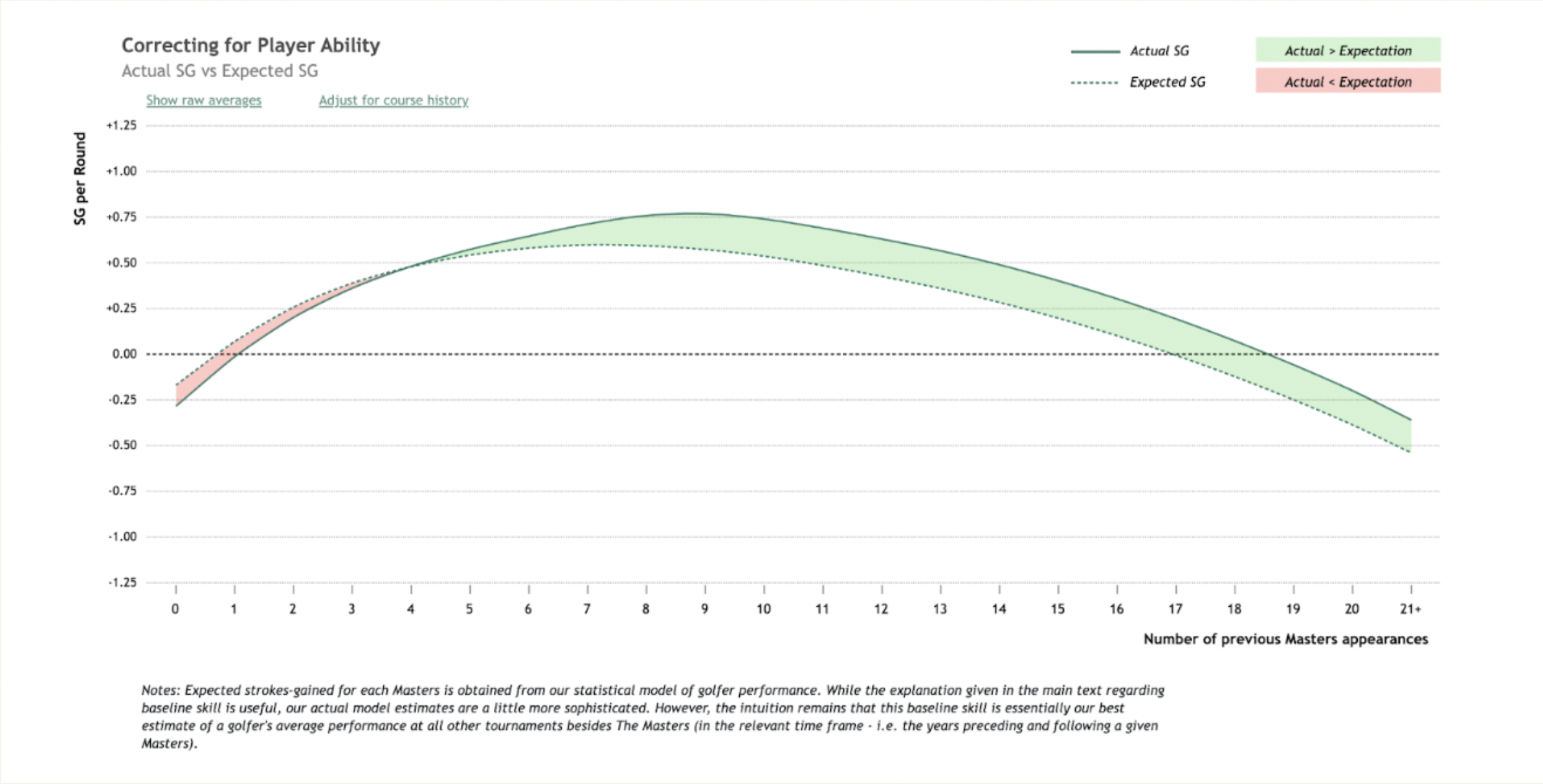
Most tour courses, because of the softer and slower greens, what you see is what you get, but the firmness, severe runoffs, and speed of Augusta make it much more difficult to navigate. There are intricacies to the course, like certain greens that break more than they look, or areas of the course where the ball travels farther. The famous example is that when Phil stood on the 16th green in 2004, he hit one less club than he normally would because he and Bones figured out that, for whatever reason, the ball always travels farther here.
But the rookie drought overstates the case. No first-timer has won since Fuzzy Zoeller in 1979, but there are a plethora of near misses. Dan Pohl lost in a playoff in 1982. Jason Day finished T-2 in 2011. Jordan Spieth and Jonas Blixt both finished T-2 in 2014. Sungjae Im shot 15-under in 2020 to finish T-2. Zalatoris was solo second in 2021. Ludvig Aberg was second in 2024. Those seven second places could have easily yielded two wins with a couple of bounces.
#7: Winning the Par 3 Contest is a Curse: MYTH
The Par 3 Contest began in 1960 with Sam Snead winning the inaugural playing. No player has won on Wednesday and gone on to win the tournament that week. Somewhere, over the decades, the word ‘curse’ emerged, and it has stuck.
The methodology for testing it requires some work. Covers.com has published odds for every Masters dating back to 1985. Seven par 3 winners since then weren’t individually listed — they were buried in the field price — so their odds had to be estimated using their Data Golf rankings and the odds of the lowest-listed player that year. Before 1983, there were no odds and no official world rankings aside from Mark McCormack’s top five. Isao Aoki, Tom Watson, and Arnold Palmer appear in those rankings and could be assigned rough figures; others required estimating from their form heading into the event.
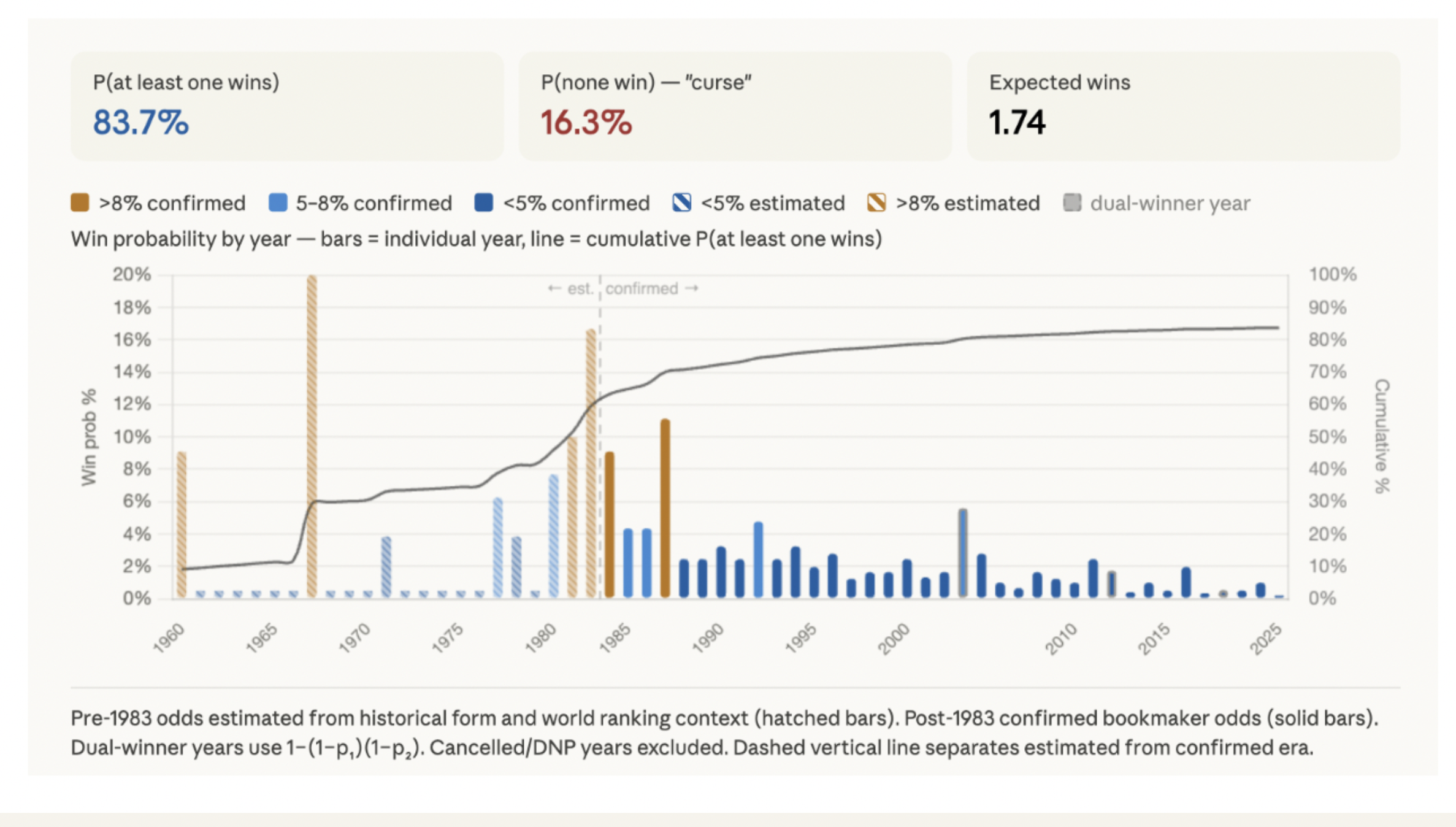
Accounting for the implied probability of each par 3 winner going on to claim the jacket, the data shows there was roughly a 16.3% chance of no winner ever emerging from that group. That’s not nothing, but it’s also not a curse.
It’s also worth noting that in the early decades, more players treated it like a formal competition. The best players in the world have increasingly stopped competing. In 2024, of the 80 players in the field, just 16 turned in complete scores, with many of the world’s best forgoing the competition. The winner is now almost always a long shot by definition. Since 2005, no par 3 winner has entered the week with odds shorter than +4000. The average odds for the 18 winners in that span is just over +18000.